A plain-English guide to protecting your Medicare card, understanding the dates on it, and knowing what to do if it is lost, damaged, or already laminated.
Questions? Call 833-265-9655
Medicare Card at a Glance
Quick Answer
No, you should not laminate your Medicare card. Use a removable plastic sleeve instead. Your red, white, and blue Original Medicare card does not normally expire — the dates printed on it show when your Part A and Part B coverage started, not when the card expires.
Lamination
No. It is better not to laminate your Medicare card. Lamination can make the card harder to scan, copy, or verify and may interfere with security features built into the card.
The Social Security Administration advises against laminating government-issued cards because lamination can prevent detection of security features. Medicare follows similar guidance. Although your Medicare card and your Social Security card are different documents, the same principle applies: lamination can create problems without protecting the card any better than a simple plastic sleeve.
The better choice is a removable clear plastic sleeve or a Medicare card holder. It keeps the card clean and dry without permanently altering it.
Recommended alternative
A clear, removable plastic sleeve protects your Medicare card from wear, moisture, and everyday damage — without making it harder to read, scan, or copy. Providers can still remove the card when they need it.
Why lamination causes problems
Have a question about your Medicare card or coverage? A licensed Lehigh Partners agent can help.
Ask a QuestionLegality
Laminating a Medicare card is generally not framed as a legal issue. The issue is that it is not recommended — not that you are likely to face any legal consequence for doing it.
The practical concern is straightforward: if lamination makes the card difficult to read, scan, or verify, you may have trouble using it at a doctor's office, pharmacy, or hospital. The fix is to request a replacement, which is free and simple through Medicare.gov.
If you have already laminated your card and everything is still working fine, you are not in any immediate trouble. If providers are struggling to process it, that is when a replacement makes sense.
Laminating your Medicare card is not recommended, but it is not a crisis. If the card still works, use it. If it does not, order a free replacement at Medicare.gov or call 1-800-MEDICARE.
Already Did It?
If your card is still readable and your providers have been accepting it without issue, you do not need to take immediate action. Many laminated cards continue to work without problems.
If the card has become hard to read, has been rejected by a provider, or the lamination is separating and damaging the card, requesting a replacement is the right move. The process is simple and free.
Replacement Medicare cards are free. You can order one online at Medicare.gov or by calling 1-800-MEDICARE (1-800-633-4227). TTY: 1-877-486-2048.
Check your laminated card:
If you answered yes to any problem above, request a free replacement through Medicare.gov or call 1-800-MEDICARE.
Expiration
Original Medicare cards do not usually expire. Your red, white, and blue Medicare card remains valid as long as you are enrolled in Medicare. There is no expiration date printed on it, and there is no annual renewal process for the card itself.
Your Medicare card does not usually expire, but your coverage can still change. If you enroll in a Medicare Advantage plan, switch plans, lose eligibility for Part B, or make other coverage changes, your actual benefits and which card to show at the doctor may be different — even though the physical card does not technically expire.
Bottom line
The card does not expire, but your coverage situation can change. If you are not sure whether your current coverage is still the right fit, a licensed Medicare agent can help you review your options.
The Dates on Your Card
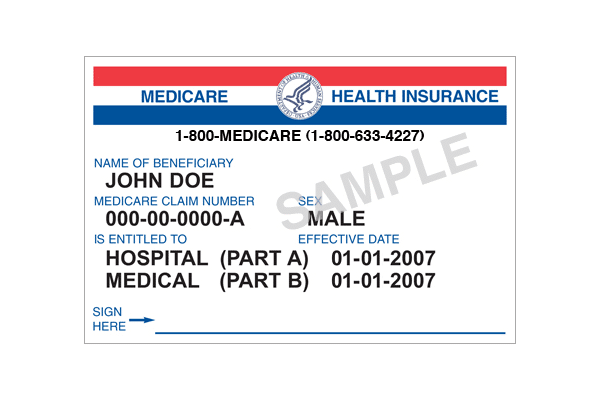
Original Medicare cards do not show an expiration date. The dates printed on the card are not expiration dates — they are the dates your Part A and Part B coverage became effective.
Many people see the dates next to "Hospital (Part A)" and "Medical (Part B)" and assume one of them might be an expiration. It is a natural assumption, but it is not correct. Those are coverage start dates. The card does not include a date it expires because Original Medicare cards do not expire the way an insurance card from a private plan might.
The dates on your Medicare card are coverage start dates, not expiration dates.
Common confusion
Some people have a Part A effective date in one year and a Part B date in another. That does not mean one of them is an expiration. It simply means Part A and Part B coverage started at different times — which is common for people who delayed Part B while still working and covered by employer insurance.
Plan Cards
Private plan cards work differently from your Original Medicare card. If you have a Medicare Advantage plan, a Part D prescription drug plan, a dental or vision plan, or a Medicare Supplement policy, those plan cards may be reissued or replaced when:
If you have Medicare Advantage, you typically present your Advantage plan card at the doctor or pharmacy. However, you should still keep your Original Medicare card in a secure place. Some providers or situations may require it, and it serves as proof of your underlying Medicare eligibility.
Not sure which card to bring to your doctor? Lehigh Partners can walk you through how your coverage works together.
Get HelpEveryday Use
Bring your Medicare card when you visit a doctor, hospital, pharmacy, lab, imaging center, or any healthcare provider that may need to verify your coverage. If you are not going somewhere that requires it, there is no need to carry it every day.
Treat your Medicare number like other sensitive personal information. Do not share it with anyone who contacts you unexpectedly, anyone offering free items in exchange for your number, or any person or organization you did not reach out to first. Medicare fraud is real, and your Medicare number is valuable to identity thieves.
Protect your Medicare number
Only share your Medicare number with your doctor, pharmacist, hospital, insurer, Medicare directly, or other trusted healthcare organizations you have contacted. If you believe someone else may be using your Medicare number, call 1-800-MEDICARE immediately.
Card Care
A removable sleeve protects your Medicare card without permanently altering it. Here are the most practical steps to keep your card in good shape and your Medicare number secure.
Replacement
If your Medicare card is lost, stolen, damaged, or unreadable — including because it was laminated — you can request a replacement at no cost. Medicare replacement cards are free.
Replacement cards are mailed to your address on file with Social Security. Allow a few weeks for the physical card to arrive. In the meantime, you can print a temporary copy from Medicare.gov.
Replacing a plan card
If you need to replace a Medicare Advantage, Part D, dental, vision, or Medicare Supplement card, contact that insurance company directly. They handle their own card replacements, separate from Medicare.gov.
Watch out for scams
Medicare will never call you unsolicited to verify card information or request payment for a replacement card. Replacement cards are always free. If someone contacts you claiming you need to pay for a new Medicare card, do not engage — report it to 1-800-MEDICARE.
Key Takeaways
The dates on your Medicare card are coverage start dates, not expiration dates.
A removable sleeve protects your Medicare card without permanently altering it.
Your Medicare card does not usually expire, but your coverage can still change.
Medicare Guidance
A question about your Medicare card is often a sign of a bigger question about your coverage. If you are not sure whether you have the right plan, which card to show at the doctor, or how Original Medicare and a Medicare Advantage or Supplement plan work together, a licensed Medicare agent can help you sort it out.
Lehigh Partners Senior Benefits works with Medicare beneficiaries to review coverage options, explain how plans work, and make sure your cards, coverage, and providers all line up. There is no pressure and no obligation to enroll.
Call Lehigh Partners Senior Benefits at 833-265-9655, or compare your Medicare options online. We can help you understand your coverage and make sure you are using the right card at the right time.
Common Questions
If you have Original Medicare, Medicare Advantage, Part D, or a Medicare Supplement plan, it can be confusing to know which card to show at the doctor, pharmacy, or hospital. Lehigh Partners Senior Benefits can help you understand your coverage in plain English.
No pressure. No obligation. Just clear Medicare guidance.
Lehigh Partners Senior Benefits is a licensed insurance agency and is not connected with or endorsed by the U.S. government or the federal Medicare program.