Medigap · 2026 Rate Increase Report & Switch Review

Medicare Supplement Rate Increases in 2026: What Policyholders Need to Know

Medicare Supplement premiums are rising sharply in many states in 2026. Recent filings show double-digit increases across numerous carriers and markets — the amount depends on your company, state, plan letter, rating method and policy block. See what's happening, why, and whether another insurer may offer your plan at a different premium.

Helping Medicare clients since 2003 — one-on-one guidance, not a call center.

The Medigap Premium & Switch Review Checks

  • Why your premium increased
  • Whether another company offers your plan letter
  • Whether health questions may apply
  • The safest order to switch, if you decide to
  • Whether keeping your plan is the better call
Licensed advisors — no separate consultation fee

Licensed Medicare Agents

Helping clients compare Medigap since 2003.

No Call-Center Pressure

No rushed decision. No obligation to switch.

Keep Your Policy While You Check

Checking your options does not cancel anything.

Rates Vary by Company

Same plan letter, different premiums.

How Much Are Medicare Supplement Rates Going Up in 2026?

There is no single nationwide Medicare Supplement rate increase for 2026. Increases vary by company, state, plan letter and policy block. Some 2026 filings show increases in the teens and 20% range, while individual filings in certain states have reached 30%–40%.

Independent reporting backs this up. Early-2026 Plan G filings from several of the largest national carriers showed increases ranging from just over 12% to more than 26% in the states examined, according to actuarial data cited by CBS News and KFF Health News. Some individual companies and states have seen far larger increases in specific policy blocks.

CompanyStateExample 2026 IncreaseEffective Date
American Benefit LifePennsylvania▲ 19.0%Oct. 1, 2026
American Benefit LifeIllinois▲ 30.0%Sept. 1, 2026
American Benefit LifeNebraska▲ 40.0%Nov. 1, 2026
American Benefit LifeTexas▲ Up to 20.9%Sept. 1, 2026
AARP / UnitedHealthcareNew Jersey▲ Up to 25.7%Aug. 1, 2026
Heartland National LifePennsylvania▲ 19.5%Oct. 1, 2026
USAA LifePennsylvania▲ Up to 15.0%June 1, 2026

Scroll to see more →

Key: Under 10% 10%–19.9% 20% and above

Sources & methodology: carrier and state rate filings reviewed by Lehigh Partners, compiled from CSG Actuarial's monthly Medicare Supplement rate-change reports; corroborating reporting from CBS News and KFF Health News on 2026 Medigap rate actions. Rates shown are examples and vary by state, plan and policy block.

These examples are drawn from carrier rate-change filings we track and do not mean every policyholder with these companies receives the same increase. Medigap rates vary by state, plan, policy block and rating method — see the state pages below for ZIP-level detail, or find out whether the same coverage is available from another company at a lower rate.

There Are Two Different Reasons Your Medigap Premium Can Increase

Most rate-increase confusion comes down to conflating these two mechanisms. It helps to know which one (or both) applies to your notice.

Age-related increases

Tied to your birthday, not the company's finances

If your policy is attained-age rated, your premium can rise simply because you got a year older — separate from any company-wide rate action.

Carrier / block rate increases

Applied to an entire class of policyholders

The insurer can also raise rates for an entire policy block because of claims experience, healthcare utilization, medical inflation and other actuarial factors — regardless of your individual age or health.

You can therefore see an age-related increase, a carrier rate increase, or both on the same notice. The pricing method your policy uses (community-rated, issue-age-rated, or attained-age-rated) determines whether age plays a role at all.

Why Are Medigap Increases So High in 2026?

Reporting from CBS News and KFF Health News points to several forces hitting the Medigap market at the same time: rising medical-service utilization, an aging policyholder base, higher labor and medical costs, and claims experience within individual policy blocks. Industry sources quoted in that reporting describe a market shift — increases that were commonly 3%–5% a year in some states are now landing in the double digits, and in some cases considerably higher.

That's a different story than the usual "healthcare costs go up every year" explanation. What's happening in 2026 is carriers correcting rates across specific blocks and states, which is why the size of the increase can look so different from one company — or even one state filing — to the next.

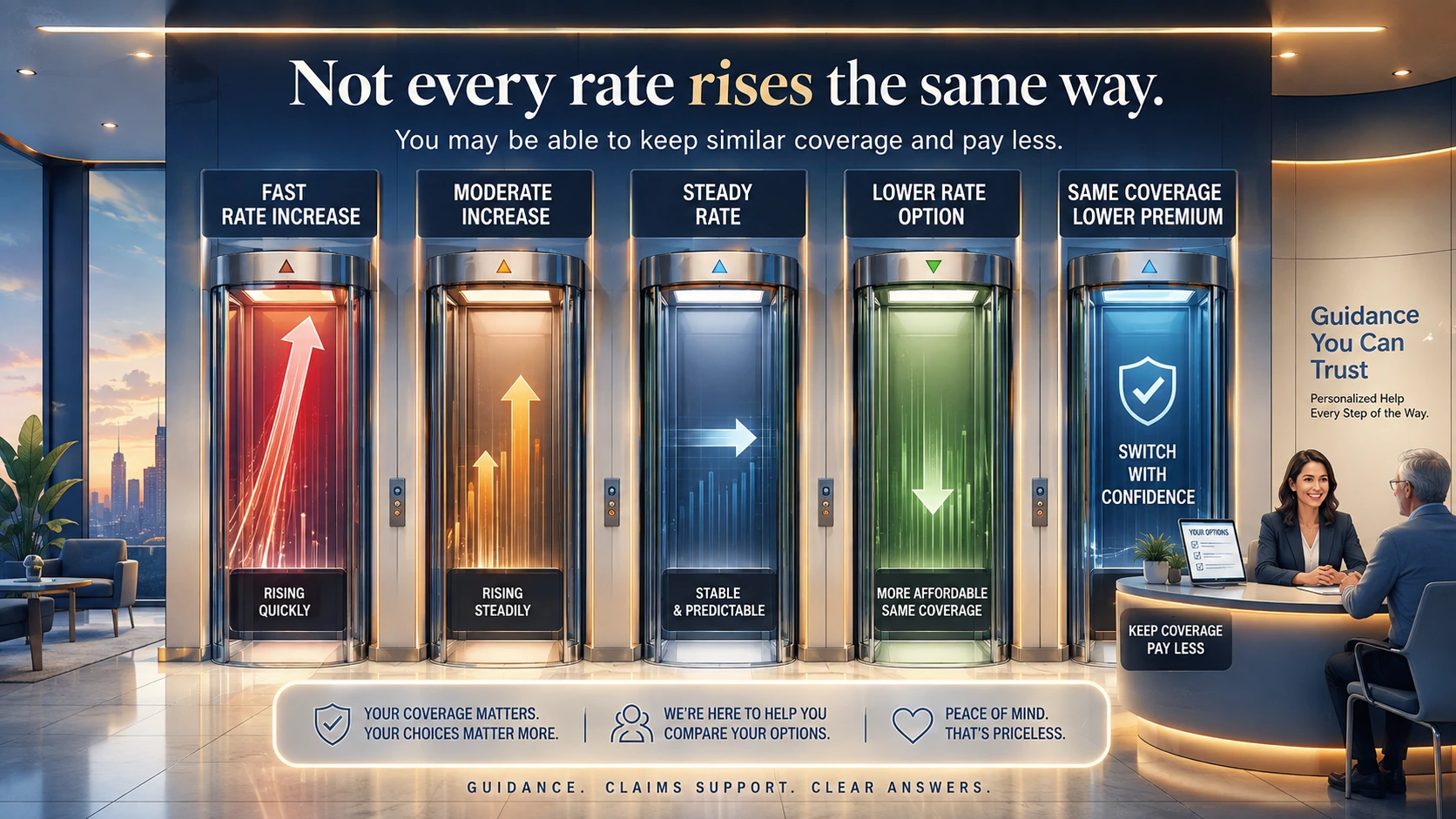
Illustration of different Medicare Supplement rate increase paths — fast, moderate, steady or lower — with guidance to compare your options

Which Medicare Supplement Companies Are Raising Rates in 2026?

We track individual state filings rather than assigning any company a single national percentage, because Medigap rate actions are approved state by state and block by block. Here's what our tracked filings show for several major carriers.

American Benefit Life Medicare Supplement Rate Increases

Yes — American Benefit Life increased rates across numerous states in 2026, with tracked filings ranging from about 14% (North Carolina) to 40% (Nebraska and Nevada). Pennsylvania and Texas filings landed at 19.0% and up to 20.9% respectively. American Benefit Life is part of Liberty Bankers Insurance Group. See the Pennsylvania and Texas pages for plan-by-plan detail.

AARP / UnitedHealthcare Medicare Supplement Rate Increases

UnitedHealthcare's AARP-branded Medigap plans have shown rate changes that vary widely by underwriting entity and state — our tracked New Jersey filings range from about 11.5% to 25.7% depending on plan letter and issuing company. Rate history for AARP/UHC should be checked at the state and plan level rather than assumed to be one national figure.

USAA Medicare Supplement Rate Increases

USAA's 2026 filings vary by state — for example, a Pennsylvania filing effective June 1, 2026 showed Plan A unchanged, Plan B up 8.0%, Plan F up 14.0%, and Plan G and Plan N each up 15.0%. Other states in our tracked filings range from 0% to as high as the mid-teens depending on plan letter.

Heartland National Life Medicare Supplement Rate Increases

Heartland National Life's tracked 2026 filings show increases in the high teens to mid-20s depending on state — 19.5% in Pennsylvania effective October 1, 2026, and 25.0% in West Virginia, both across Plans A, B/C, G and N where applicable.

Physicians Life & HealthSpring Medicare Supplement Rate Increases

Physicians Life's tracked filings range from about 5% (Arkansas) to 29% (Michigan). HealthSpring National Health's filings vary even more widely by state — from 0% in some markets to over 40% in others, and reached the low 50s in one Wyoming filing — underscoring how much these increases differ by state rather than following one company-wide number.

Increases above are drawn from carrier rate-change filings we track and are examples, not guarantees of what any individual policyholder will see. Your notice reflects your specific state, plan letter and policy block — if yours is on this list, it's worth checking whether the same plan letter is priced lower elsewhere.

Medicare Supplement Rate Increases by State

The national data above gives you the big picture. For ZIP-level before-and-after premiums, plan-by-plan detail and market-by-market comparisons, see the full state reports below.

More states are added to this directory as verified filing and quote data becomes available.

A Premium Increase Is Not a Cancellation

Your benefits may not have changed, but your premium did. Your policy can remain active as long as you continue meeting its requirements, including paying the new premium.

You generally have three choices: keep your current policy and pay the new premium, apply for similar coverage from another insurance company, or review whether a different Medicare coverage strategy makes sense. Because Medigap benefits are standardized by plan letter, another company may offer the same Medicare Supplement coverage at a lower premium. For many people, the safest starting point is simply finding out whether another Medicare Supplement company may offer a suitable option — you do not have to cancel your plan to check, and you do not have to commit to switching.

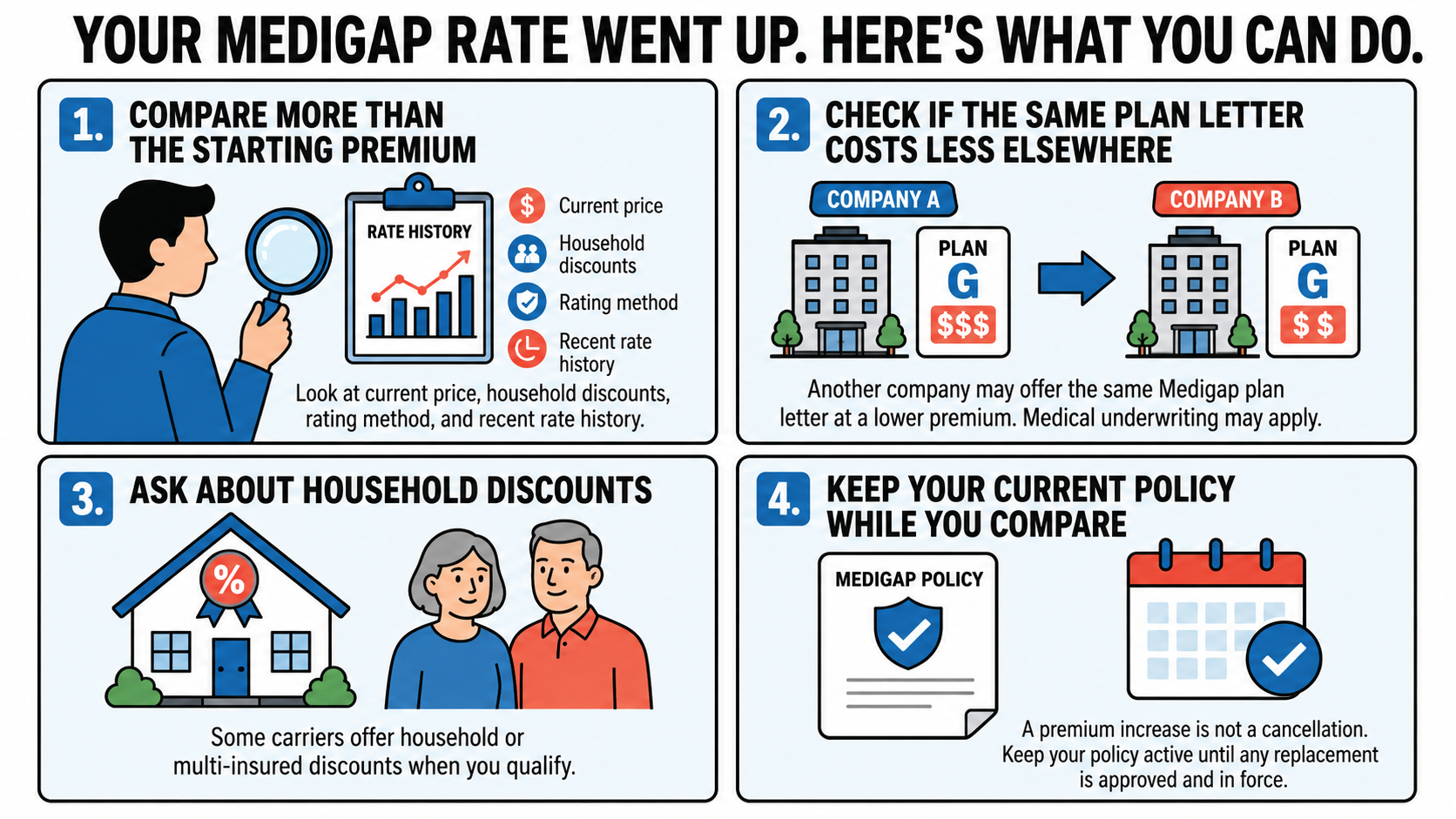
Your Medigap rate went up, here's what you can do: 1) Compare more than the starting premium — look at current price, household discounts, rating method and recent rate history. 2) Check if the same plan letter costs less elsewhere — another company may offer the same Medigap plan letter at a lower premium; medical underwriting may apply. 3) Ask about household discounts — some carriers offer household or multi-insured discounts when you qualify. 4) Keep your current policy while you compare — a premium increase is not a cancellation; keep your policy active until any replacement is approved and in force.

Three simple steps, no obligation

You don't need to understand every Medicare rule before asking for help. Have your plan letter and current premium handy if you know them — that's it.

1

Compare

We look at the plan you have, the new premium, and the relevant Medicare Supplement options offered by the insurers we represent.

2

Qualify

We help determine whether health questions, timing, or state protections may affect your ability to change companies.

3

Protect

You keep your current policy in place unless and until another policy is approved and ready to begin.

Check Whether I Can Lower My Medigap Premium

Checking does not cancel or change your current policy.

Your questions, answered quickly

Your concernThe answer
Can I check without canceling?Yes
Is switching guaranteed?No
Could the same plan cost differently elsewhere?Yes
May health questions apply?Yes
What should I do first?Compare while keeping your policy

Let's Check Whether You Have Another Medigap Option

Choose a time for your Medigap Premium & Switch Review. After selecting a time, tell us about your current plan, premium, and rate increase so we can prepare for the conversation.

What you'll know after the review

  • Whether another relevant option may be available
  • Whether health questions may apply
  • Whether switching appears worthwhile for you
  • How to avoid canceling too early
Without the review: you're deciding based only on the increase notice.
With the review: you know your options, whether you qualify, and how to protect the coverage you already have.

Checking your options does not cancel or change your current Medicare Supplement policy.
No separate consultation fee. No obligation to switch.

Prefer to talk first? Call 833-265-9655.

Why Am I Paying More If My Benefits Did Not Improve?

That is one of the most common and reasonable questions people ask after a Medigap rate increase. Your premium can rise for several reasons, even when your plan's benefits stay exactly the same — whether it's your policy's pricing method, rising healthcare costs, or a rate change approved for your policy block. We break down each of these in detail, including how attained-age, issue-age and community-rated pricing works, in our full guide to why Medicare Supplement rates increase.

Understanding why the increase happened will not lower the bill by itself. But it helps you compare your options without feeling pressured into the wrong move.

See real 2026 rate examples. We compared before-and-after Plan G and Plan N premiums by ZIP code as part of our broader look at 2026 Medicare Supplement rate increases: see verified Pennsylvania Medicare Supplement rate increases or see verified Texas Medicare Supplement rate increases.

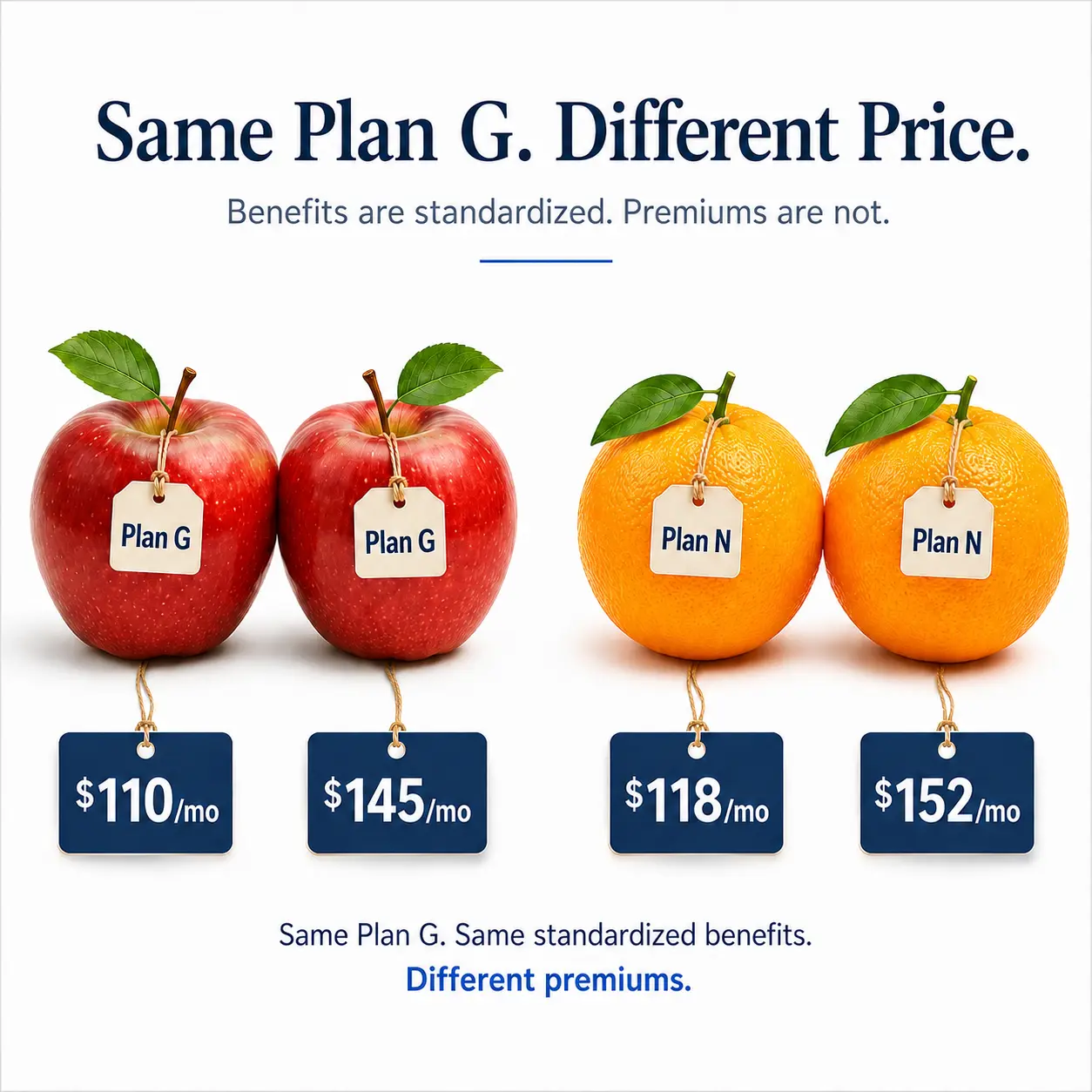
Apples-to-apples comparison of identical Medicare Supplement plan benefits sold by different insurance companies at different premiums

Plan benefits are standardized. Premiums are not.

In most states, a standard Plan G from one company generally provides the same basic medical benefits as a standard Plan G from another company — but premiums, discounts, and future rate history are not standardized. The same is true comparing a standard Plan N across companies. Massachusetts, Minnesota, and Wisconsin follow different state-specific rules. It is not guaranteed that another company will approve your application or offer a lower premium — that's why we compare the whole situation, not just the lowest number on a quote. See how the same coverage can carry a different price tag.

Check Whether I Can Lower My Medigap Premium

Pick a time that works — most rate reviews take 20–30 minutes.

Will I Have to Answer Health Questions?

You may. Outside certain protected situations, a new insurance company may use medical underwriting — health questions used to decide whether to approve your application. Your ability to change companies may depend on your health history, your state and ZIP code, your current plan and how long you've had it, the new company's underwriting rules, and whether a federal or state protection applies.

Some situations give you stronger rights to buy another policy without being rejected. Your six-month Medigap Open Enrollment Period is one type of protection; certain life events may create separate guaranteed-issue rights. These are not the same thing, and your state may provide additional opportunities beyond the federal rules. We will check whether one of those situations applies to you — you do not need to determine which rule applies on your own. When you are ready, see how to apply for another Medicare Supplement policy.

You don't have to become a Medicare expert to make a good decision here. That's what the review is for.

We are not a national call center

Lehigh Partners Senior Benefits has helped Medicare clients since 2003. You work with a licensed advisor — not a call-center script — who explains what you have now, compares what may be available, points out the risks before you change anything, and recommends keeping your current policy when that's the better answer.

  • Licensed Medicare advisors — not customer service reps
  • Compare your current carrier against other represented companies
  • Plain-English explanations — no jargon
  • No separate consultation fee, no obligation to switch
Check Whether I Can Lower My Medigap Premium Call 833-265-9655
Lehigh Partners Senior Benefits
DS
David Scallion Founder & Licensed Medicare Advisor
GC
Gina Chandler Licensed Medicare Advisor
DR
Danny Rodriguez Licensed Medicare Advisor

"We help people understand what they're buying and why — not just push them toward the easiest option."

— David Scallion, Founder

What Clients Say About Comparing Medicare Options With Us

What real clients say about comparing options with our help.

★★★★★

“Dave helped me understand Medicare part B, C, & D, plus all the various supplement plans. He presented me with various scenarios that even projected monthly and annual costs. Dave was patient answering all my questions and even assisted in some of the application process.”

Robert Haffner Google review
★★★★★

“Dave was very helpful in finding me the best product to meet my needs at the lowest cost. Very efficient, thoughtful and available.”

Susan Peck Google review
★★★★★

“David is very knowledgeable about the plans available and is an expert on Medicare — always ready to answer questions and clarify information.”

Bob Bromiley Google review

Do Not Cancel the Plan You Have Until the New One Is Approved

The order matters.

1

Apply while your current policy remains active

Keep paying the premium on the coverage you already have while the new application is being reviewed.

2

Wait for documented approval

Submitting an application does not mean it has been approved. Wait until the new insurer confirms approval and an effective date.

3

Cancel the old policy only after the replacement is secured

Coordinate cancellation carefully after the new policy has been approved and its effective date confirmed.

Do not cancel your current policy just to see whether another company will accept you. If the new application is declined, your existing policy should remain in place as long as you kept it active and continued paying the required premium.

The Questions Most People Ask Before Switching

Will my benefits be worse?

Not necessarily. When you compare the same standardized plan letter, the basic medical benefits are generally the same. However, the premium, discounts, service, pricing method, and future rate history may differ.

What happens if the new company declines me?

Your current policy is not automatically canceled because another insurer declines your application. That is why you keep your present coverage active while checking other options.

Do I need to wait for the Medicare Annual Enrollment Period?

Generally, no. Medicare Supplement policies are not tied to the October 15 through December 7 Annual Enrollment Period the way Medicare Advantage and Part D plans are — you may apply at other times of the year.

Should I drop Medigap because the premium increased?

Not before you understand what you may be giving up. Dropping your policy without suitable replacement coverage could leave you responsible for more costs under Original Medicare, and it may be harder to obtain another Medicare Supplement policy later.

You Do Not Have to Guess

You may be able to switch. You may find another company offers the same plan letter at a more suitable premium. You may also discover your present policy remains the best choice available. Your health, timing, location, and available protections can affect your future options — reviewing the increase now lets you decide while your existing policy is still safely in place.

Checking your options does not cancel or change your current policy. No separate consultation fee. No obligation to switch.

And if keeping your current Medicare Supplement policy is the right decision, we will tell you.

2026 rate increase & switching questions

No. A premium increase changes what you must pay to keep the policy. It does not, by itself, mean the insurer canceled your coverage.
Possibly. In most states, the same standardized plan letter provides the same basic medical benefits regardless of the company selling it. Premiums and approval requirements may differ.
You may apply at different times of the year, but acceptance is not guaranteed. Health questions may apply outside a protected enrollment situation.
Medicare Supplement policies work with Original Medicare rather than a Medicare Advantage provider network. You can generally use providers who accept Medicare, but you should confirm your specific coverage before making a change.
Yes. A company may decline an application when medical underwriting is allowed. Certain federal or state protections may give you stronger rights in specific situations.
No. Keep your current policy active while the new application is reviewed. Cancel only after the replacement has been approved and its effective date has been confirmed.
Not in the same way it applies to Medicare Advantage and Part D. You may apply for Medigap at other times, although underwriting and state rules may affect approval.
Not when you are comparing the same standardized plan letter's basic medical benefits. Learn why the same Medigap plan can have different prices. However, price is not the only factor. Discounts, rating methods, service, approval requirements, and future rate changes should also be considered.
There is no single nationwide number. Increases vary by company, state, plan and policy block. Recent 2026 carrier filings we track show increases mostly in the teens and 20% range, with some individual filings reaching 30%–40%.
Carriers cite rising medical utilization, an aging policyholder base, higher healthcare costs, and claims experience within a policy block. Some companies are also correcting rates that were priced low when the policy was first sold.
Yes. Most Medigap policies can see a rate change most years, either from aging (if attained-age-rated), a carrier-wide block increase, or both. There is no rule limiting increases to a certain number of years.
Not because of your individual claims. Medigap rate increases are typically applied to an entire class or policy block based on that group's overall claims experience, not to one person's usage.
It depends on the carrier and state — there is no consistent rule that one plan letter increases more than another. Some filings show similar percentage increases across Plan G and Plan N; others differ by several points.

Lehigh Partners Senior Benefits is a licensed insurance agency and is not connected with or endorsed by the United States government or the federal Medicare program. We do not offer every plan available in your area. We represent selected insurance organizations and products in the areas we serve. Contact Medicare.gov or 1-800-MEDICARE for information about all available options. Plan availability, premiums, underwriting requirements, guaranteed-issue rights, and state protections vary. This page provides general educational information and is not a substitute for advice based on your individual circumstances. Submitting a review request does not guarantee eligibility, approval, savings, or the availability of a lower-premium policy.