You're not alone. Seniors across the country are receiving these messages by text, phone, and email. This page shows you the exact documented scripts — word for word — so you can recognize them. Then we'll show you what's actually real and how to check what real benefits may be available in your ZIP code.
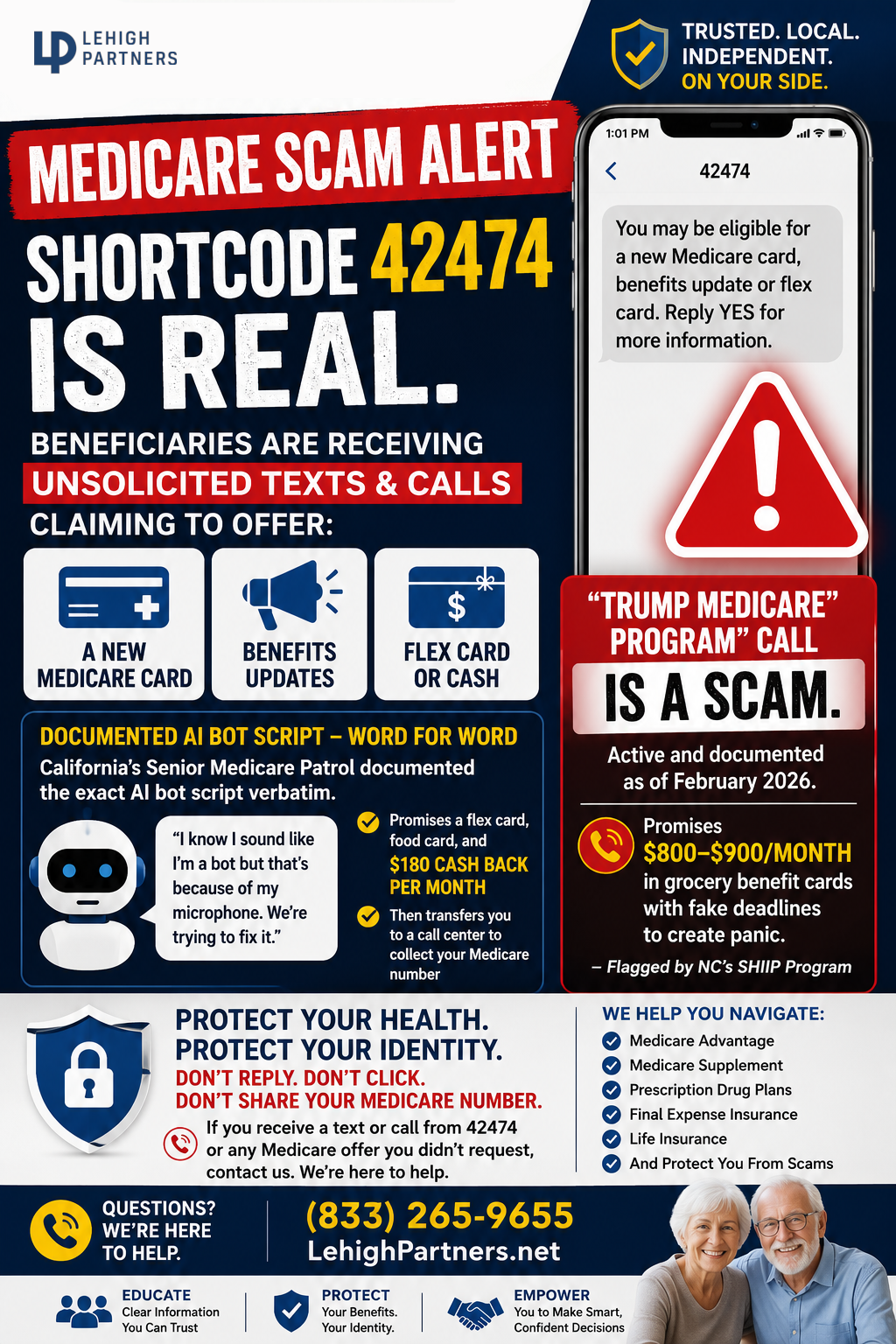
The short answer
Here is what you need to know before scrolling to the exact messages.
Medicare itself does not send texts, emails, or AI robocalls offering flex cards, grocery cards, or spending cards. Unsolicited messages promising $900, $2,100, or $180 cash back per month are not from the government and are not legitimate Medicare benefits.
Some Medicare Advantage plans — private insurance plans that replace Original Medicare — do include OTC allowances, grocery credits, and flex-style benefits for qualifying members. Amounts depend entirely on your county, your plan, and your eligibility. A licensed agent can check at no cost.
The exact messages seniors are receiving
These are sourced from Senior Medicare Patrol reports, SHIIP advisories, and CMS warnings — not hypothetical examples.
Sent via shortcode 42474 and spoofed local numbers — flagged by CMS and state insurance departments
AI robocalls and live scammers using documented scripts — reported by California Health Advocates SMP and NC SHIIP
Official-looking sender addresses, government logos, and formal language — designed to pass inbox filters
How to recognize them
If a message you received matches two or more of these, stop and verify through 1-800-MEDICARE or a licensed agent before taking any action.
Real Medicare and insurance communications address you by name. Generic greetings mean the sender does not have your actual account information.
Every documented scam uses fake urgency. Real Medicare enrollment periods are published months in advance and do not expire by text.
Medicare does not initiate contact by text or email to offer benefits. If you did not ask for it, it is not coming from Medicare.
Domains like "medicare-secure-benefits-gov.com" or "cms-enrollment-center.net" are not government sites. The real Medicare website is Medicare.gov only.
The documented AI script is programmed to deny being a robot. Any caller that says "I am a human" when you ask is almost certainly not.
Real flex and grocery benefits exist but are plan-specific and often reserved for people with dual Medicare and Medicaid eligibility or specific chronic conditions.
Documented 2026 scams use the phrase "Trump Medicare Program." No Medicare benefit is named after any individual. Government name-dropping is a trust tactic.
Together, these two numbers are sufficient for full medical identity theft. No legitimate enrollment process requests both by phone, text, or email.
What is actually available
The ads are misleading. The scam calls are fraudulent. But some real benefits are worth knowing about.
What a real flex card or OTC card is: A prepaid benefit card issued by a private Medicare Advantage plan — not by the government. It can cover over-the-counter medications, eligible grocery items, dental copays, vision, hearing, and sometimes utilities. You receive it only after enrolling in a qualifying plan that includes the benefit for members in your county.
Who actually qualifies for higher amounts: Grocery allowances above $50–$100 per month are typically reserved for people who qualify for both Medicare and Medicaid (dual eligibility) or who have specific chronic health conditions. You cannot apply for a flex card separately from a plan.
How to check what is real in your area: A licensed Medicare agent uses your ZIP code to look up every Medicare Advantage plan available in your county and what extra benefits each one includes. This comparison costs nothing and has no obligation to switch. Read our full guide on OTC card and flex card eligibility, or use the Medicare Checkpoint to review whether your current coverage is the best fit overall.
Official sources
The documented messages on this page are sourced from official Medicare, Senior Medicare Patrol, SHIIP, FTC, and state consumer protection alerts — not fabricated examples.
Helpful places to verify or report a Medicare message you received:
Medicare.gov — Report Medicare fraud and abuse
Senior Medicare Patrol National Resource Center — smpresource.org
FTC ReportFraud.gov
Find your local SHIP / SHIIP counseling program — shiphelp.org
Common questions
What to do next
We'll look up every Medicare Advantage plan available in your county and show you exactly what OTC, grocery, flex card, and other extra benefits are actually available — and what they cover. No pressure. No switching required.
If you received a text, call, or email about a Medicare flex card, grocery card, or new Medicare card, we can help you check whether it looks legitimate before you respond.
If you want to know whether real OTC, grocery, dental, vision, or flex-style benefits are available in your ZIP code, start with our full eligibility guide.
Free Medicare Scam & Benefits Check
Enter your ZIP code and phone number. A licensed agent will check whether the message you received looks legitimate and what real extra benefits may actually be available in your area.